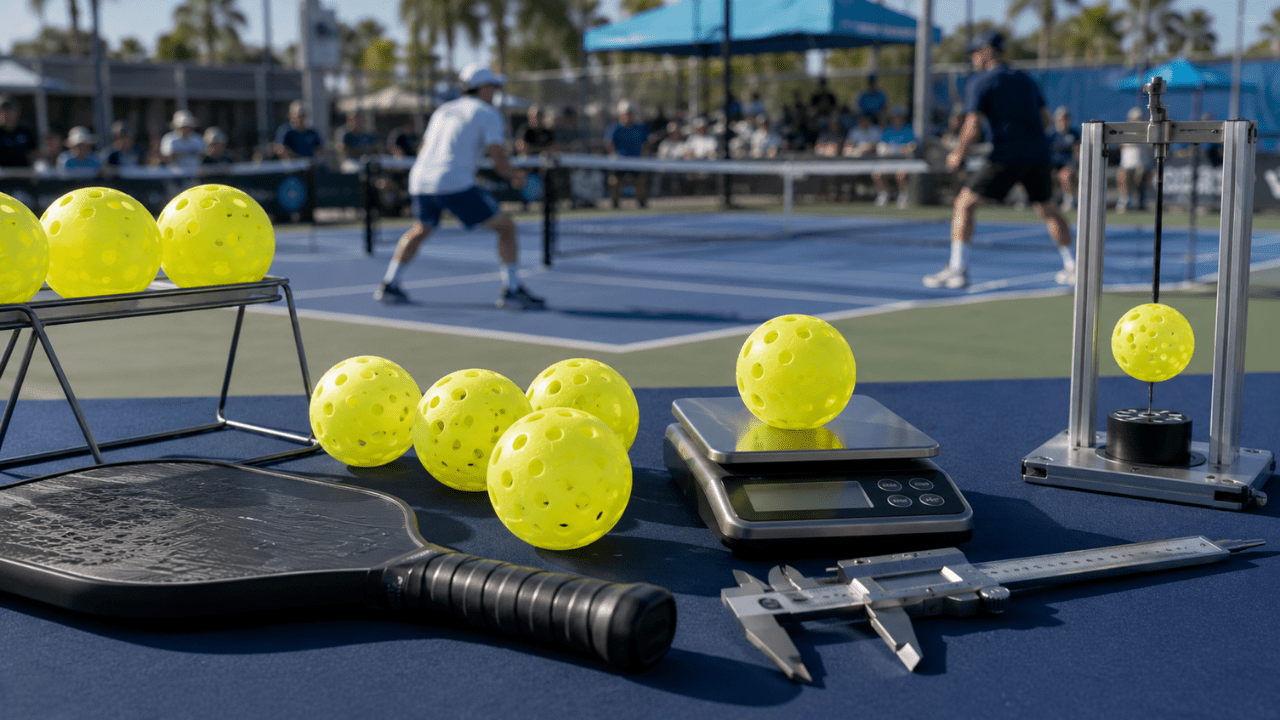
USA Pickleball approved balls are ball models that have been submitted by a manufacturer, tested against a published set of specifications, and listed as legal for sanctioned play. That is the whole definition. Approval is a compliance check on size, weight, bounce, hole pattern, surface and colour; it is not a quality rating, a performance ranking, or a statement that one ball plays better than another.
That distinction matters more than it sounds, because “approved” is doing a lot of marketing work on product pages. Two balls can both be approved and still feel completely different in the hand, crack at different rates, and suit different courts. The label tells you a ball is eligible to be used. Choosing between eligible balls is a separate decision, and it is the one this guide is really about.
If you only take one action from this page, make it this: check the exact model name against the official USA Pickleball approved equipment database, not the brand name on the box.
What Does “USA Pickleball Approved” Actually Mean?
When a ball is approved, USA Pickleball confirms one thing: this model, as manufactured, falls within the tolerances laid out in the Equipment Standards Manual. It can therefore be used in tournaments and leagues that operate under USA Pickleball rules.
You will still see the phrase “USAPA approved pickleballs” in older listings and forum posts. USAPA stood for the USA Pickleball Association, which rebranded to USA Pickleball in 2020. The terms refer to the same certification, so a seller using the older wording is not necessarily wrong, though it can be a sign the listing has not been updated in a while.
Two things approval does not mean. It does not mean the ball is durable, nor does it carry over to other products from the same manufacturer. Approval is granted to a specific model. A brand can have one approved ball in its range and several that are not, which is exactly why the model-level check matters.
The Specifications a Ball Must Meet to Be Approved
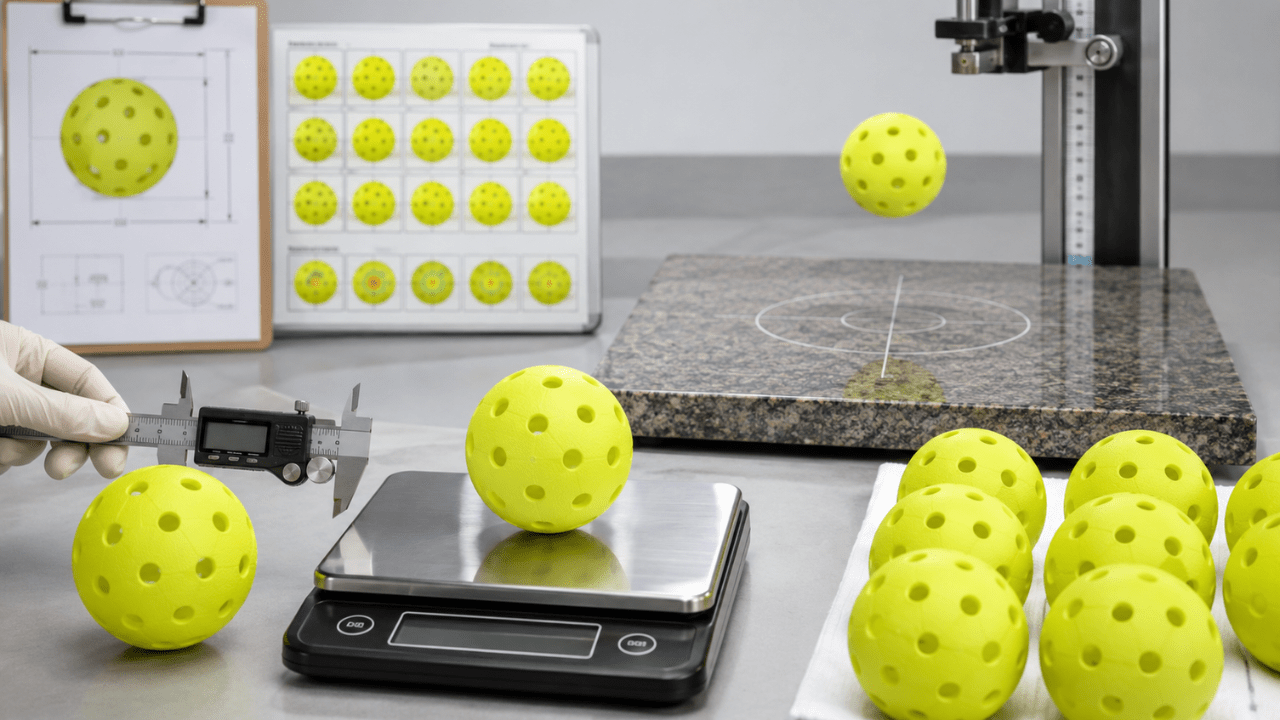
The standards are refreshingly concrete. Under the USA Pickleball Official Rulebook, an approved ball has to satisfy all of the following.
Size and Weight
Diameter must fall between 2.874 and 2.972 inches, and weight between 0.78 and 0.935 ounces. Those windows are narrow enough that balls at opposite ends of the range genuinely feel different, which is part of why players develop strong preferences between approved models.
Bounce
Dropped from 78 inches onto a granite surface, the ball must rebound between 30 and 34 inches. Bounce is temperature sensitive, so testing is done under controlled conditions. This is also the spec most likely to drift as a ball ages and softens.
Holes
A pickleball has no fewer than 26 and no more than 40 holes, arranged in a symmetrical pattern so flight stays predictable regardless of orientation. Hole count and size are the main visible difference between indoor and outdoor balls.
Surface and Colour
The surface must be smooth and free of texturing, which prevents manufacturers from engineering extra spin into the ball itself. The ball must be a single uniform colour apart from identification markings. Any colour is permissible, so long as it is consistent.
How a Ball Gets on the USA Pickleball Approved Ball List
The process is manufacturer-initiated. A company registers with the USA Pickleball equipment programme, pays the applicable fees, and submits production samples rather than prototypes, since the point is to verify what buyers will actually receive. Samples go through independent testing against every specification above, and results are reported back over a period of weeks.
Models that pass are published in the searchable equipment database. Approval is not permanent: if production quality drifts outside the tolerances, a listing can be pulled. The current requirements and timelines are documented in the equipment submission FAQ.
For a buyer, the useful implication is that the database is the single source of truth. Packaging can be reprinted, product pages can lag, and third-party listings copy each other. The database is what a tournament director will check.
Do You Actually Need Tournament Approved Pickleballs?
It depends entirely on where you play.
For sanctioned tournaments and most organised league play, yes. Official pickleballs from the approved list are mandatory, and the tournament will usually specify the exact model in advance so competitors can practise with it.
For recreational play, open play at your local courts, or a driveway game, no. There is no rule requiring an approved ball, and plenty of perfectly good balls are not on the list, often because the manufacturer never paid to submit them rather than because they failed anything.
That said, most competitive players standardise on approved balls anyway, for a practical reason rather than a regulatory one: if you train with a ball that bounces differently from the one you will compete with, you are calibrating your touch to the wrong feedback. The dink game in particular is sensitive to this.
Indoor vs Outdoor Approved Balls: Not Interchangeable
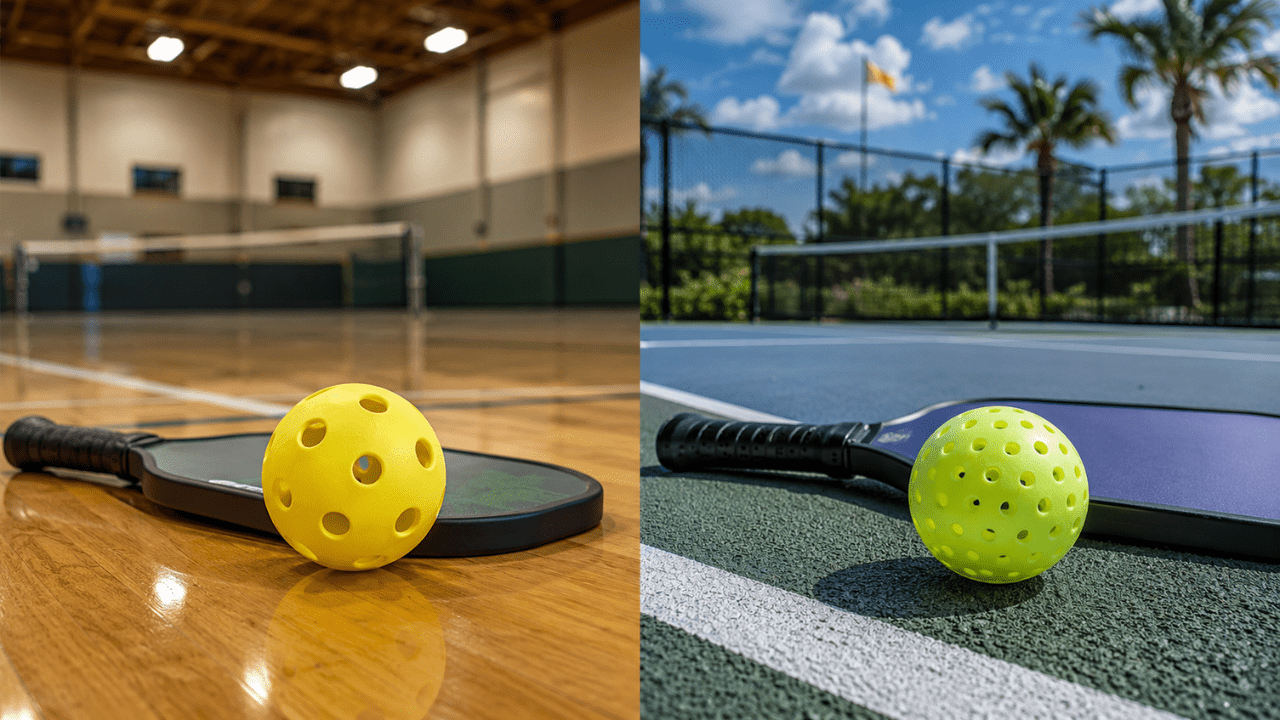
Both indoor and outdoor balls appear on the approved list, and confusing the two is one of the more common buying mistakes.
Outdoor balls have smaller, more numerous holes, and are heavier and harder. That combination resists wind and survives abrasive outdoor surfaces, at the cost of being less forgiving on the paddle. Indoor balls have larger holes, are lighter and softer, and are built for smooth gym floors, where they offer more control and a slower game.
Approval says nothing about which one you need. Match the ball to the surface you play on. If you are curious about why the two constructions behave so differently, our guide to what pickleballs are made of covers the material side in more detail.
How to Choose the Best USA Pickleball Approved Balls
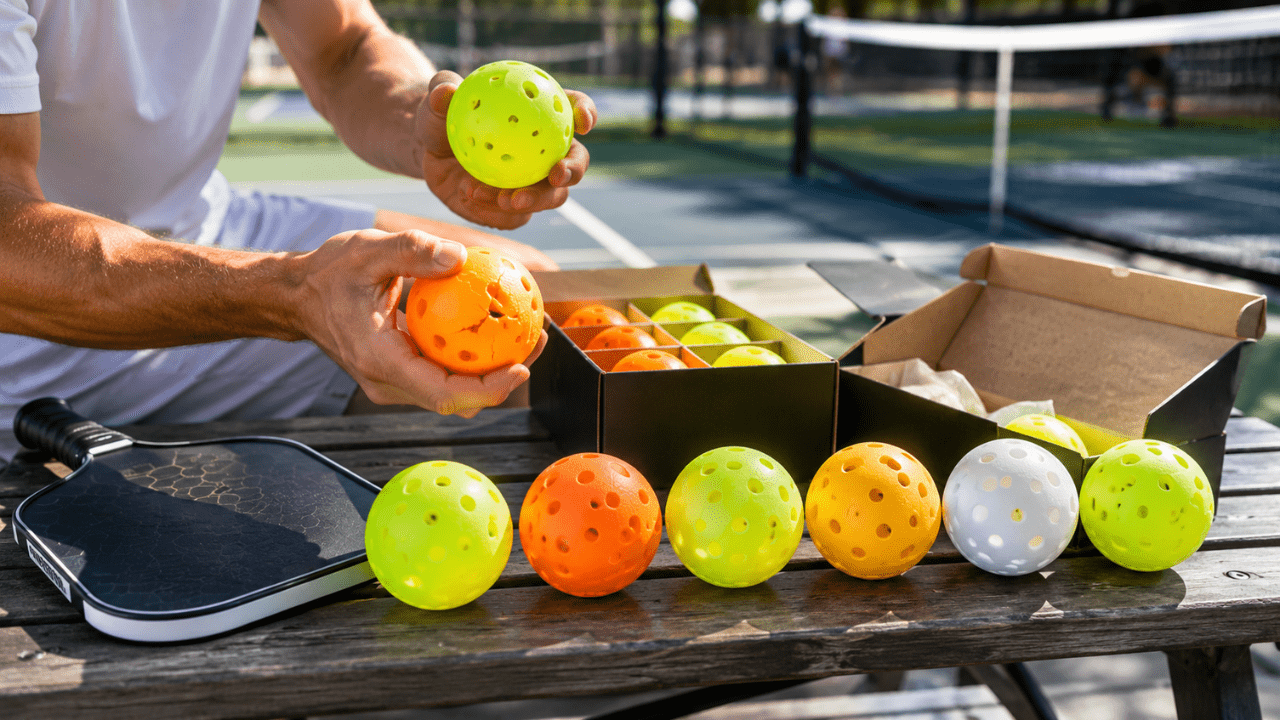
Once you have filtered to approved models, the real comparison starts. These are the variables worth weighing.
Durability. This is the biggest differentiator and the one most likely to determine what you actually spend over a season. Outdoor balls crack, particularly in cold weather, and crack rates vary widely between approved models. Our breakdown of how long pickleballs last goes into what drives that.
Bounce consistency. Buy a sleeve, not a single ball, and check that bounce is even across the set. Inconsistency within a batch is a quality-control signal.
Visibility. Colour is unregulated beyond being uniform, so choose for contrast against your usual court surface and lighting rather than for looks.
Noise. Harder balls are louder, and court noise is an increasingly live issue for clubs near residential areas. If your venue has had complaints, this is worth factoring in.
Cost per playable hour. A cheaper ball that cracks in two sessions is not cheaper. Divide price by realistic playing life and compare on that basis instead.
Where to Buy USA Pickleball Approved Balls
Buy from the manufacturer directly or from an authorised retailer, and verify the model name in the official database before checking out.
The main thing to watch for is language that gestures at approval without claiming it. Phrases like “tournament style”, “tournament grade”, or “meets USAPA specifications” are not the same as being listed. A ball that is genuinely approved will say so with the model name, and you will be able to find that model in the database. If you cannot find it, treat the claim as marketing.
Also check that the packaging names the approved model rather than just the brand, since manufacturers often sell approved and non-approved balls under very similar names.
Our USAPA approved pickleballs are made from recycled ocean-bound plastic and sold directly by us, which removes the authorised-retailer question entirely. And to be consistent with everything above: look our model up in the database yourself. Any brand asking you to verify claims should expect the same standard applied to itself.
Can an Approved Ball Also Be Sustainable?
Yes, and this is worth stating plainly because the assumption often runs the other way.
The specifications govern dimensions, bounce, surface and colour. They say nothing about what the plastic is made from or where it came from. A ball produced using recycled material can meet every requirement on the list, because approval is measured on how the finished ball performs, not on the origin of its feedstock.
So the choice between tournament legality and lower environmental impact is a false one. Where the real trade-off currently sits is between recycled and bio-based materials, which we cover in our comparison of recyclable vs biodegradable pickleballs.
At Evolute Pickleball, that is the approach: recycled ocean-bound plastic, designed to be recyclable at end of life, built to meet the same approved standards competitive players rely on. You can read more about the thinking in our guide to the rise of sustainable pickleball design.
Key Takeaways
USA Pickleball approved means a specific ball model has been tested against published specifications and listed as legal for sanctioned play. It is not a quality ranking.
The specs are fixed: 2.874 to 2.972 inches in diameter, 0.78 to 0.935 ounces, a 30 to 34 inch bounce from 78 inches, 26 to 40 symmetrical holes, a smooth surface, and one uniform colour.
USAPA approved and USA Pickleball approved refer to the same certification; the organisation rebranded in 2020.
Approved balls are required for sanctioned tournaments and most leagues, but not for recreational play.
Approval is granted per model, not per brand, so always verify the exact model in the official database.
Indoor and outdoor balls are both approved but are not interchangeable; match the ball to the surface.
Recycled materials and approval are fully compatible, since the standards regulate performance rather than feedstock.