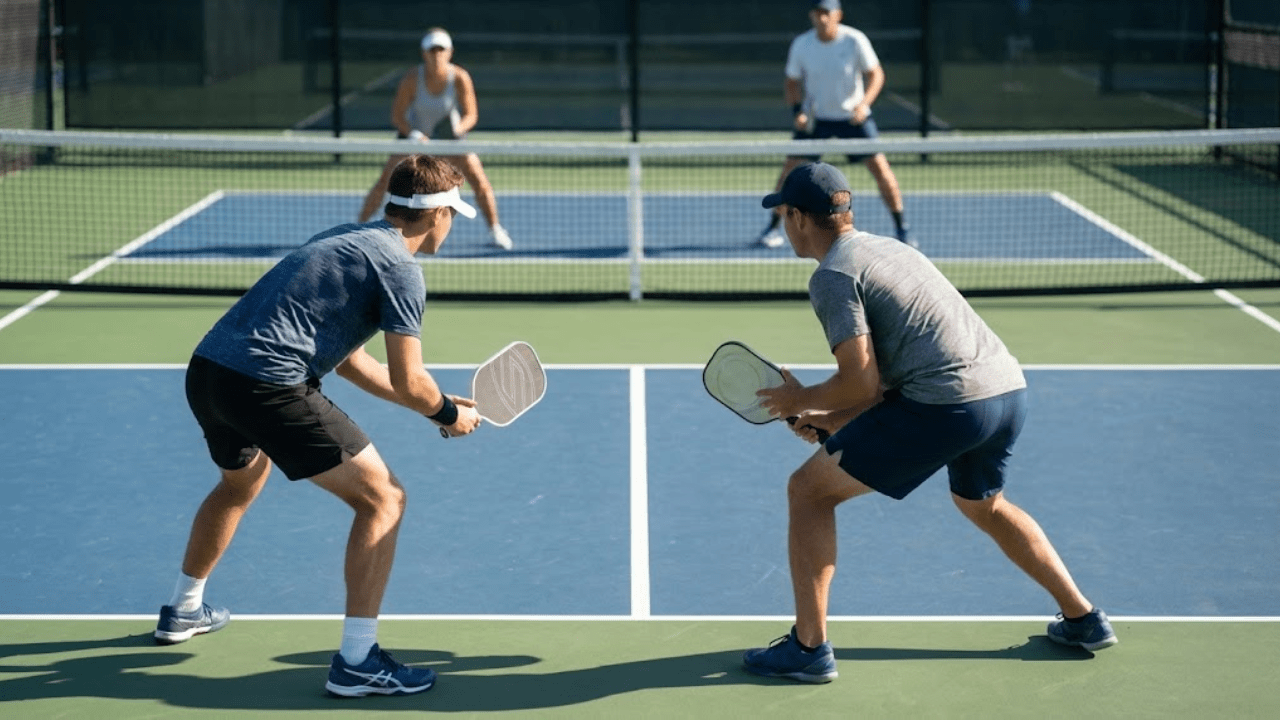
Pickleball rewards intelligence as much as athleticism. While many players focus on paddle technology or spin techniques, one foundational factor shapes every rally: pickleball court size.
Understanding the official pickleball court dimensions changes how you move, where you position yourself, and which pickleball shots you select. The compact layout encourages precision, timing, and patience over brute power.
In this guide, we break down how court size directly influences strategy, movement patterns, and shot selection. Whether you play singles or doubles, mastering the court dimensions can dramatically improve your consistency and control. At Evolute Pickleball, smarter play and responsible gear go hand in hand. When you combine intelligent strategy with sustainable equipment, you elevate both your performance and the sport’s future.
Understanding Official Pickleball Court Dimensions
Before discussing strategy, it is essential to understand the numbers.
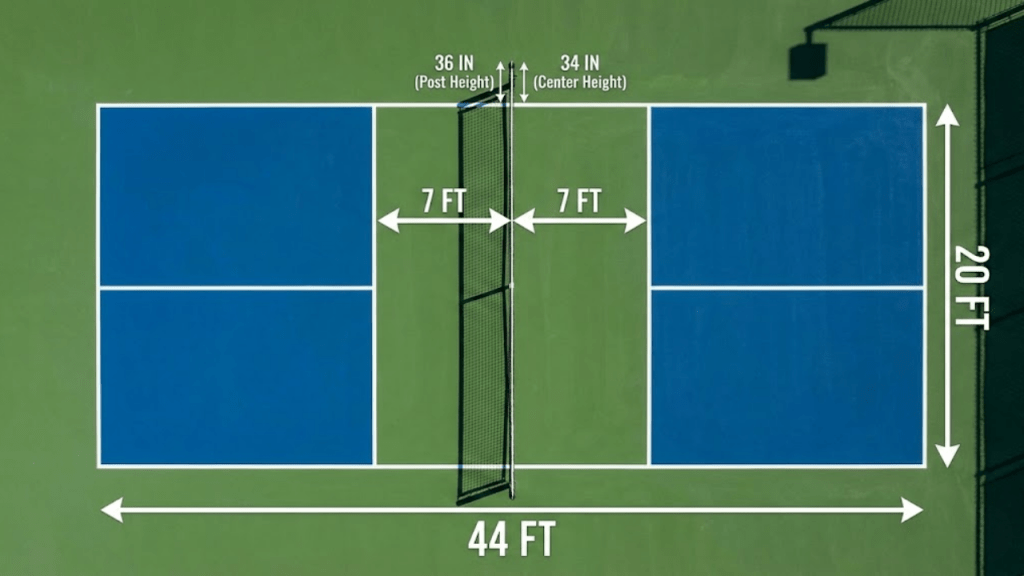
According to USA Pickleball rules, the official pickleball court size measures:
- 20 feet wide
- 44 feet long
- The same dimensions for both singles and doubles
Each side includes a 7-foot non-volley zone (NVZ) extending from the net. This area, commonly called “the kitchen,” prevents players from volleying while standing inside it.
Key Measurements
- Net height: 36 inches at the sidelines
- Net height: 34 inches at the center
- Service courts: Divided into right and left halves behind the NVZ
- Baseline: The back boundary line
These standardized dimensions ensure consistency across recreational and professional play.
But more importantly, they define how rallies unfold.
Why Pickleball Court Size Matters Strategically
The relatively small court size compared to tennis changes everything.
Because the court is compact:
- Reaction time is shorter
- Angles are sharper
- Power alone is rarely enough
- Positioning becomes critical
When analyzing how court size affects pickleball strategy, one principle stands out:
Placement beats power.
The short length limits deep lobs. The narrow width rewards cross-court angles. The presence of the NVZ encourages soft, controlled exchanges rather than constant overhead attacks.Court size is not just a measurement. It is the framework for winning pickleball strategies.
How Court Size Influences Shot Selection
1. The Third Shot Drop Becomes Essential
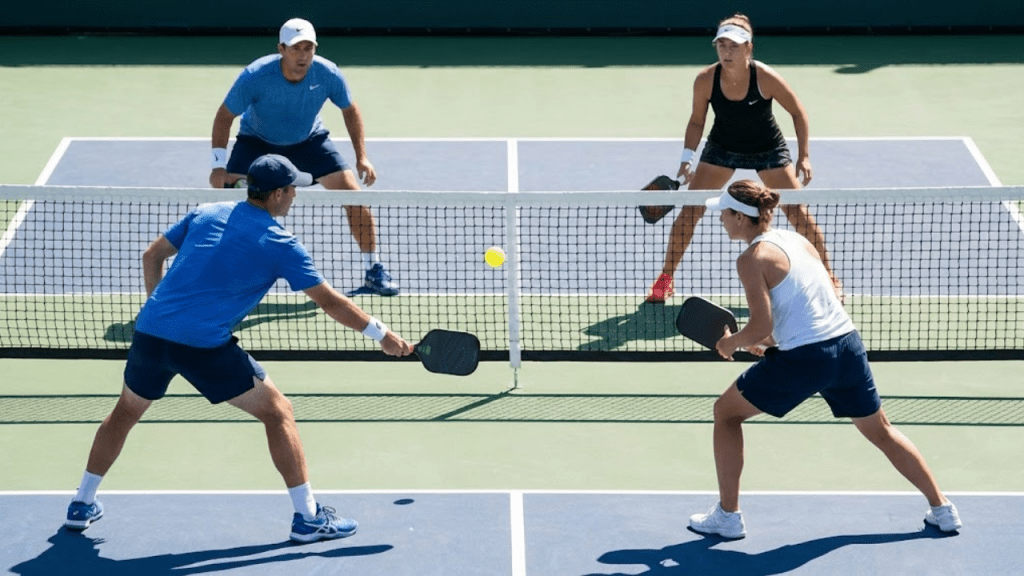
The 44-foot length means returning teams can quickly reach the kitchen line. That is why the third-shot drop is so important.
Instead of driving the ball hard and risking a counterattack, skilled players use soft drops to neutralize the rally and move forward safely.
If you want to refine this skill, explore our detailed third-shot drop techniques guide to mastering this critical shot.
The compact court rewards this controlled transition because it limits defensive spacing and forces opponents upward.
2. Cross-Court Angles Gain Value
On a 20-foot wide court, diagonal shots travel farther than straight shots. This creates a natural margin for error.
Cross-court dinks and drops:
- Increase consistency
- Force opponents to move laterally
- Create wider attack angles
The court’s width makes these high-percentage pickleball shots more reliable than risky down-the-line attempts.
3. The Non-Volley Zone Shapes Rally Dynamics
The pickleball court non volley zone is one of the sport’s defining features.
Because players cannot volley inside the NVZ:
- Soft play dominates near the net
- Patience becomes a weapon
- Positioning is critical
Most rallies are won by forcing errors rather than hitting outright winners.
This aligns closely with findings from competitive match data. If you are interested in a deeper analysis of high-percentage pickleball shots, Evolute’s breakdown of the five shots that win the most points highlights how positioning and control outperform reckless aggression.
Movement Patterns on a Regulation Pickleball Court
Understanding the standard pickleball court size should immediately influence how you move.
Ready Position and Court Coverage
Because reaction time is limited, your ready stance matters.
- Knees bent
- Paddle up and forward
- Weight slightly on the balls of your feet
- Eyes tracking the ball
The smaller court means hesitation leads to lost points.
Lateral Shuffling Over Sprinting
Unlike tennis, pickleball rarely requires long sprints.
Instead, it demands:
- Quick lateral shuffles
- Small adjustment steps
- Split-step timing at impact
Explosive but controlled movement wins points at the kitchen line. If you want to refine this skill set, our breakdown of how better movement wins more points provides a practical guide to improving footwork efficiency.
Transitioning to the Kitchen Line
Because of the official pickleball court size, the team controlling the NVZ usually controls the rally.
After serving, players should:
- Hit a third-shot drop
- Advance quickly
- Establish a position at the kitchen line
- Maintain lateral balance with their partner
This transition is one of the most important movement patterns in the game. Mastering kitchen positioning requires precise timing, balanced footwork, and coordinated movement with your partner.
If you want a deeper breakdown of how to control this space effectively, explore our guide on pickleball kitchen line footwork and positioning, which explains how better net positioning directly increases point-winning opportunities.
Doubles vs. Singles: How Court Size Changes Strategy
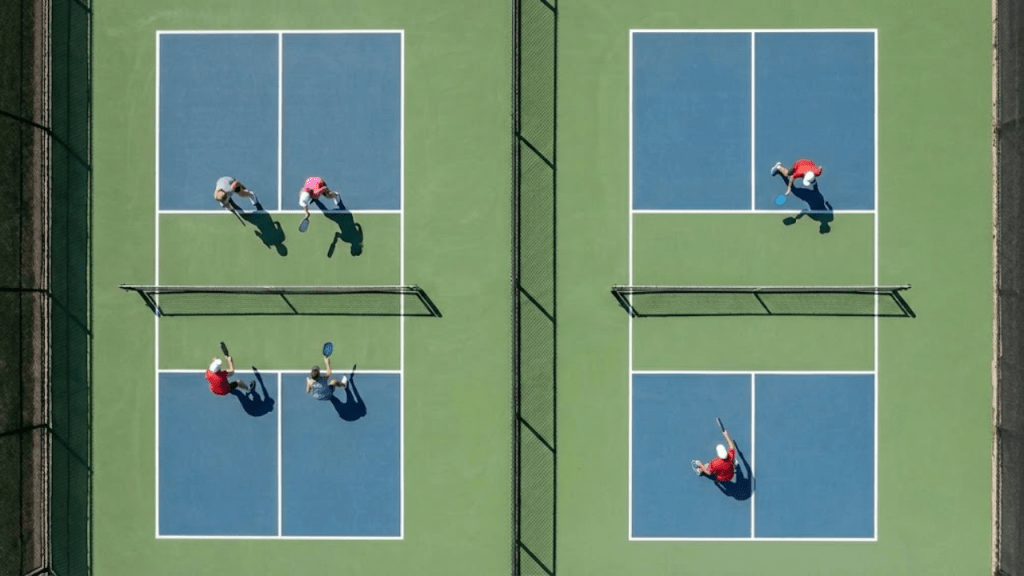
The dimensions remain the same for both formats, but coverage responsibilities differ dramatically.
Doubles
- Each player covers 10 feet width-wise
- Communication is essential
- Middle balls create confusion
- Angles are harder to defend
Because space is shared, pickleball court positioning becomes a coordinated effort.
Most winning doubles strategies emphasize:
- Controlling the middle
- Moving in unison
- Reducing open lanes
Singles
In singles, you must cover the full 20-foot width alone.
This changes shot selection:
- Passing shots become more common
- Deep corner placement gains importance
- Conditioning matters more
Singles rewards endurance and baseline consistency, while doubles emphasizes soft control and teamwork.
Court surface and ball type can also influence pace and bounce, especially when comparing indoor and outdoor play.
If you want to understand how equipment and playing environment affect strategy, explore our guide on indoor vs outdoor pickleballs and how each version impacts movement and shot selection.
How Court Size Limits Power Play
Many new players assume that harder shots win points. However, the compact 20×44 layout discourages constant aggression.
Why?
- Less room to recover after over-hitting
- Faster counters from opponents
- Smaller margins near the sidelines
The court simply does not reward reckless power.
Instead, it favors:
- Controlled drives
- Well-timed speed-ups
- Smart body targeting
- Patience during dink exchanges
Understanding the regulation pickleball court size helps players recognize that consistency outperforms flash.
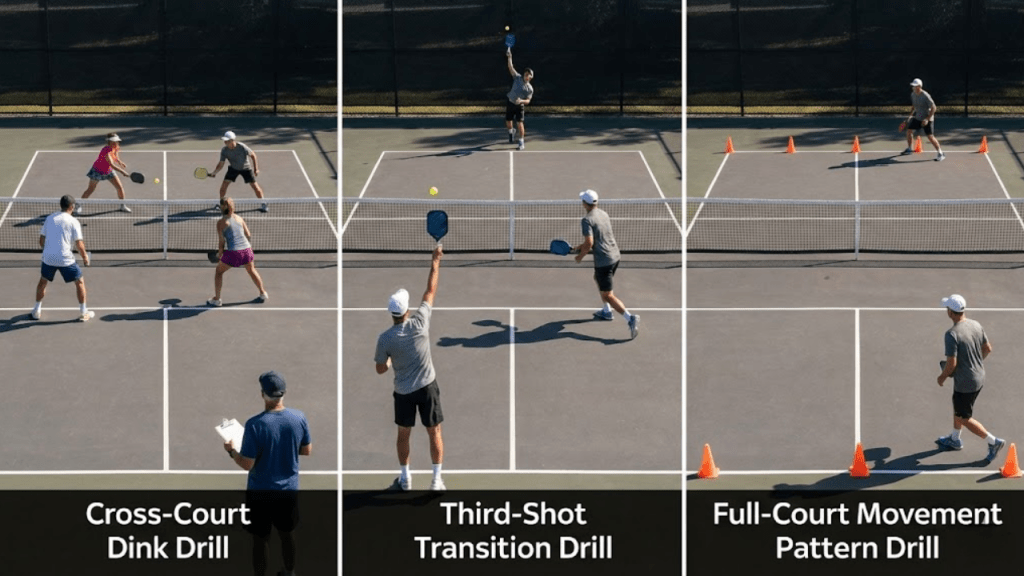
Drills to Adapt to Pickleball Court Dimensions
To improve your movement and shot selection, train specifically for the court’s structure.
1. Cross-Court Dink Drill
- Stand diagonally across from a partner
- Keep the ball within the kitchen
- Focus on angle control
This builds consistency within a limited space.
2. Third-Shot Transition Drill
- Serve
- Execute third-shot drop
- Advance immediately
- Reset at the kitchen line
This reinforces proper court progression.
3. Full-Court Movement Pattern Drill
- Start at baseline
- Shuffle laterally to the sideline
- Recover to center
- Move forward to NVZ
This simulates single coverage responsibilities.
Positioning Fundamentals for Smart Court Play
Strong positioning maximizes the advantages of official pickleball court dimensions.
Key reminders:
- Stay even with your partner in doubles
- Protect the middle
- Avoid backing up unnecessarily
- Keep paddle above waist height
- Maintain a low center of gravity
Because the court is compact, minor positional mistakes quickly turn into point losses.
Playing Smarter with Sustainable Gear
At Evolute Pickleball, we believe intelligent strategy should extend beyond the court.
Our mission focuses on:
- Recycled plastic paddle materials
- Sustainable manufacturing
- Eco-conscious packaging
- Supporting recycling initiatives
If you are curious about how performance and sustainability intersect, our blog on the recycled plastic paddle journey explains how innovation supports both athletes and the environment.
Winning more points matters. So does protecting the future of the sport.
The Bigger Picture: Court Awareness Wins Matches
The official pickleball court size is not just a rulebook detail. It shapes every rally, every movement decision, and every strategic choice.
Because the court is compact:
- Placement beats power
- Patience beats recklessness
- Positioning beats athleticism alone
The best pickleball shots are those that fit the geometry of the court.
When you understand how the dimensions influence play, your shot selection becomes smarter, your movement becomes sharper, and your confidence increases.
Final Takeaway
Mastering pickleball is not about overpowering opponents. It is about understanding space.
The 20-by-44-foot court rewards:
- Intelligent transitions
- Controlled drops
- Strategic angles
- Strong kitchen positioning
- Coordinated movement
When you align your strategy with the realities of pickleball court dimensions, you play with purpose.
Ready to elevate your game while supporting a greener future? Explore Evolute Pickleball’s eco-friendly balls and join a community committed to smarter, more sustainable performance.
Play smarter. Move better. Choose responsibly.